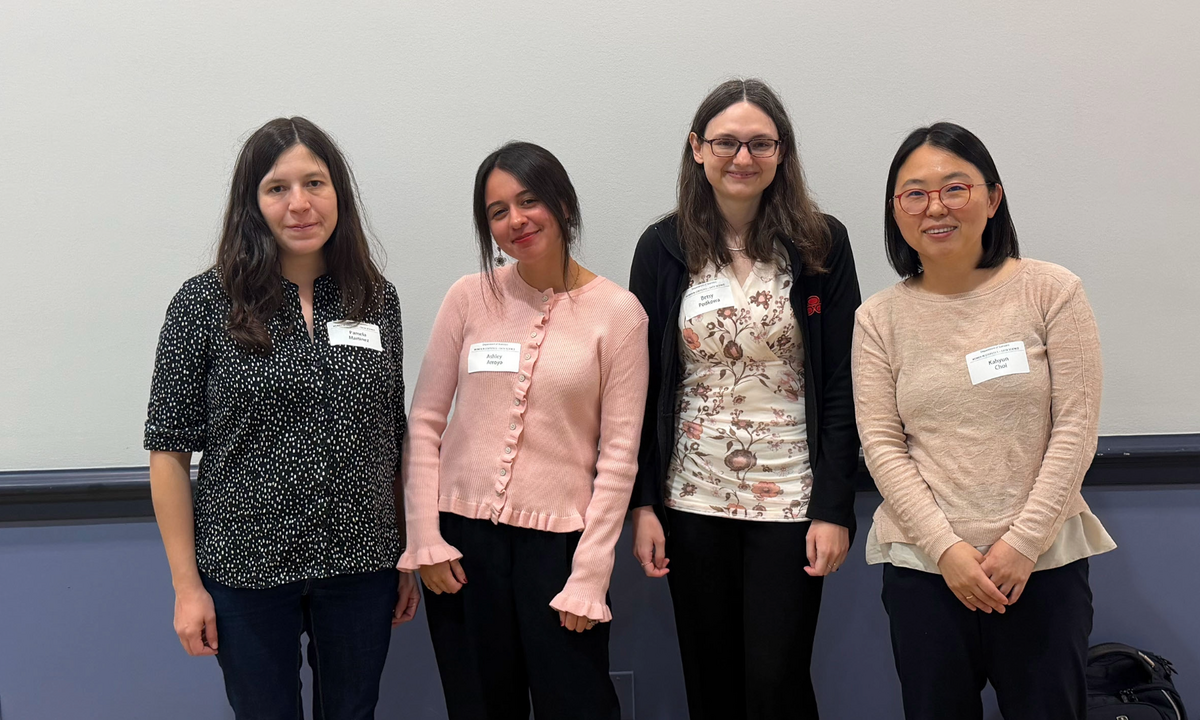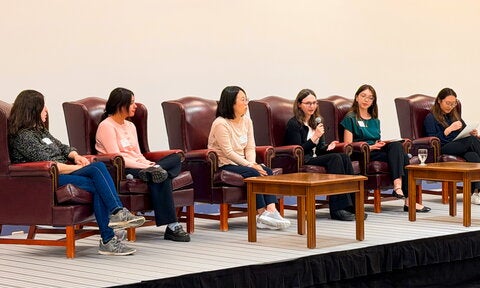
What does a career in statistics and data science look like, and how do you find your place in a field that continues to evolve? Those questions were at the center of the fourth annual Department of Statistics' Women in Statistics + Data Science event on Monday, October 26, at the Illini Union. Organized by the University of Illinois Urbana-Champaign's Department of Statistics Inclusive Excellence committee, the event provides an opportunity for current Illinois students to listen to the stories and interact with women currently working in fields related to statistics and data science.
This year's panel was moderated by Rachel Cheung (senior) and Sarah Wheeler (senior), both Information Science + Data Science majors at Illinois, who led the conversation with thoughtful, engaging topics. Panelists included Ashley Arroyo, Data Scientist at Subaru of Indiana Automotive; Kahyun Choi, Assistant Professor in the School of Information Sciences at Illinois; Pamela Martinez, Assistant Professor of Statistics and Microbiology at Illinois; and Betsy Podkowa, Lead Data Scientist at State Farm.
The discussion began with a look at how each panelist found their way into statistics and data science. With a variety of interests including mathematics, computer science, electrical engineering, biology, and statistics, it was evident early in the discussion that while similar, no two paths are the same. To some, their interests were discovered during their undergraduate studies. Others found direction through graduate school or through professional experiences.
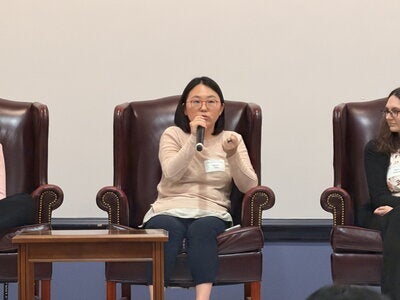
For Arroyo, who earned both her bachelor's and master's degrees in statistics at Illinois, an interest in applied mathematics eventually led her to pursue statistics. Choi combined her background in computer science with an interest in music and poetry, discovering a research area that brought data science and the arts together. Martinez's work connects statistics and mathematics with biology and public health. Meanwhile, Podkowa transitioned from electrical engineering to mathematics before entering the field through State Farm's Modeling and Analytics Graduate Network (MAGNet) program.
Navigating STEM fields as a woman and making space was a theme threaded throughout much of the evening’s conversation. Podkowa recalled feeling uncomfortable in her electrical engineering program, where only four of approximately 50 students were women. Moving into mathematics, where women made up a much larger share of her classmates, changed her perspective as she was able to find her community. For Arroyo, being one of only a few Hispanic women in the classroom added additional pressure and motivation to succeed. "The value of representation is having people you can relate to, people you can feel comfortable with sharing your experiences," Arroyo said.
For Martinez, the encouragement of strong, dedicated mentors helped build the confidence needed to explore opportunities beyond her home country of Chile. Those experiences shaped the kind of mentor she hopes to be for her own students as she hopes to give them the same encouragement and confidence that others gave her.
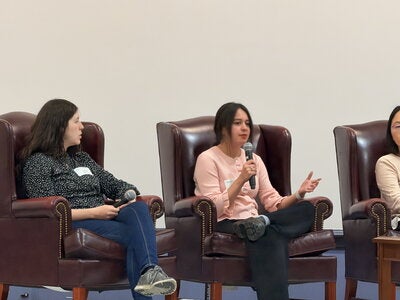
Arroyo related to the importance of having mentors—even if informal— by sharing that she was shy and still trying to find her voice early in her career. Watching other women speak confidently and stand up for themselves helped Arroyo realize she didn't have to hold back parts of herself. She described trying to change the way she presented herself to be taken more seriously, which sometimes made her less comfortable sharing who she was. "We don't always have to hide ourselves," Arroyo said.
Choi mentioned that mentorship can be effective even when informal. She recalled gaining valuable perspectives by interacting with peer students and researchers at conferences and casual gatherings. Choi shared that those connections and community were built around shared experiences and learning from one another. Like other panelists, Choi took the lessons from the informal mentorship opportunities she experienced and incorporated them into creating similar informal occasions for her students to gather and find their place. "You are not alone," Choi said. "We are in this together."
Podkowa credits State Farm's MAGNet program with helping build a sense of community early in her professional life. The relationships she formed through the program continue to influence her work as she mentors the next generation of data scientists, leading the Illinois branch of the MAGNet program. Podkowa encouraged students to advocate for themselves, even when it feels uncomfortable. "Sometimes, it's necessary to ruffle some feathers," she said, highlighting the importance of recognizing one's worth when seeking opportunities.
After the panel, Cheung and Wheeler noted they had a clearer understanding of the different types of skills that will be important as statistics and data science continue to develop. Wheeler noted that while technical knowledge remains important, the panelists' emphasis on communication, adaptability and working across disciplines stood out to her. "Especially as the tools we use continue to evolve, these are skills that will remain valuable regardless of where the field goes," she said. Cheung had a similar reaction, noting how much communication and presentation skills matter, especially when working in industry.
Both student hosts also appreciated hearing how the panelists found their way into their careers. Their experiences showed that there isn't one set path to follow, and that trying different opportunities along the way can help you figure out what you want to do.
The different roles and experiences each panelist had along the way offered reassurance that students do not need to have every step of their careers mapped out. Cheung hopes attendees left feeling more confident in exploring their options, adding, "I hope people took away that it's okay to explore until you find the career where you feel fulfilled and happy." Wheeler likewise hoped the conversation encouraged students to look beyond technical skills and recognize the value of curiosity and adaptability throughout their careers.