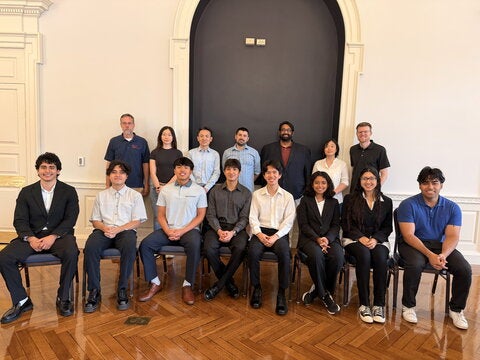
Faculty (back row): Darren Glosemeyer, Susu Zhang, Yuguo Chen, Matthew Singh, Vimal Rao, Hyoeun Lee, and Kelly Findley
Illinois undergraduate students from statistics, information sciences, and neural engineering gathered at the Illini Union on Aug. 7 to share the results of their summer research as part of the 2026 Blackwell Summer Scholars Symposium.
The symposium marked the conclusion of an eight-week research experience designed to give undergraduate students an opportunity to work closely with faculty mentors, develop research skills, and explore topics that intersect statistics, data science, and related fields.
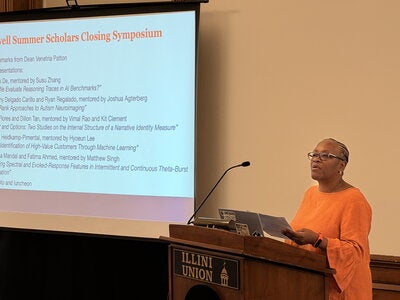
The event opened with remarks from LAS Dean Venetria Patton, who reflected on her own undergraduate experience participating in a similar research program during her junior year of college. Drawing on that experience, Patton encouraged the scholars to recognize the significance of the opportunity they had been given and noted that the Blackwell Summer Scholars program “honors the Blackwell legacy.”
Throughout the summer, the scholars worked alongside faculty mentors on projects spanning artificial intelligence, neuroimaging, machine learning, psychological measurement, and neuroscience. The symposium provided an opportunity for each scholar or research team to present their findings and discuss what they learned through the research process.
In addition to their individual research projects, the scholars participated in a series of eight-week micro-courses designed to strengthen their technical and statistical foundations. PhD student Evan Tsiamalos led a course covering topics in mathematical statistics, while PhD student Jun Hee Kim led an R programming course. Together, the courses complemented the students’ research experiences by providing additional tools and knowledge they could apply to their projects.
The scholars’ projects reflected the breadth of research being conducted in the Department of Statistics and the range of questions that can be explored through statistical and data science methods.
Shrutik De (statistics), mentored by professor Susu Zhang, examined whether artificial intelligence models can effectively evaluate the mathematical reasoning produced by other AI systems in a project titled “Can We Evaluate Reasoning Traces in AI Benchmarks?”
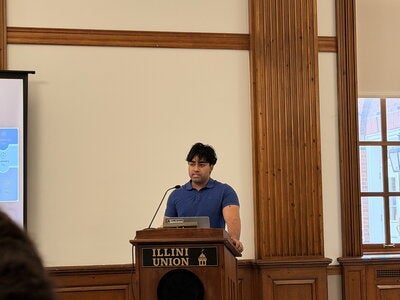
De studied mathematical reasoning traces generated by AI models and investigated whether large language models could assess the quality of that reasoning. The project found that while advanced large language models can evaluate reasoning, there are substantial differences in how models determine which reasoning behaviors should be rewarded or penalized.
For De, one of the most rewarding parts of the summer was the opportunity to present those findings at the symposium and connect with others interested in similar questions.
“My mentor helped sharpen my research focus and set it up for success,” De said, adding that the project also created opportunities for the research to be expanded in the future.
De encouraged future scholars to arrive with ideas they are genuinely excited to explore, while also embracing the freedom to experiment and try new things.
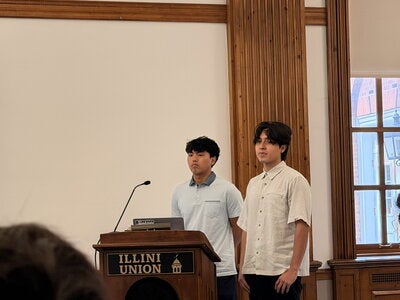
Anthony Delgado Carrillo (statistics) and Ryan Regalado (statistics), mentored by professor Joshua Agterberg, explored statistical methods for analyzing autism neuroimaging data in their project, “Low-Rank Approaches to Autism Neuroimaging.”
The pair focused on developing an interpretable model for autism neuroimaging data using an existing method known as AJIVE, extending it to incorporate a group-specific component appropriate for their data. Their resulting work produced findings consistent with current research and more robust existing models.
For Regalado, the experience offered an opportunity to experience the independence and discovery that are central to academic research.
“I realized how liberating independent research with a faculty member can be,” Regalado said. “We consistently worked toward [a] goal throughout the project, but we also asked new sub-questions along the way that led [to] interesting findings.”
Regalado’s advice for future scholars? Build a strong foundation in linear algebra.
“According to Professor Agterberg, ‘Once you've taken linear algebra, my advice is to take more linear algebra. You can never know too much linear algebra,’” Regalado said.
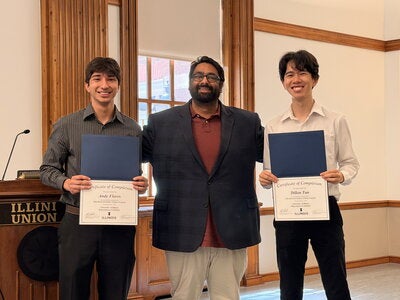
Andy Flores (statistics) and Dillon Tan (statistics), mentored by professors Vimal Rao and Kit Clement, investigated the internal structure of a narrative identity measure in their project, “Order and Options: Two Studies on the Internal Structure of a Narrative Identity Measure.”
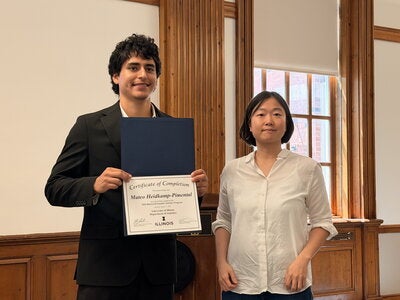
Mateo Heidkamp-Pimental (information sciences), mentored by professor Hyoeun Lee, focused on machine learning and customer behavior in “Early Identification of High-Value Customers Through Machine Learning.”
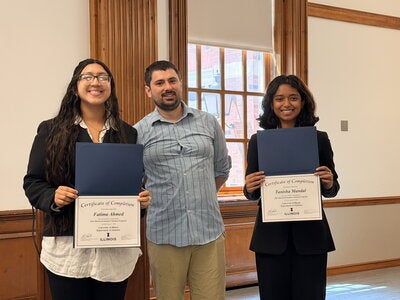
Tanisha Mandal (neural engineering) and Fatima Ahmed (neural engineering), mentored by professor Matthew Singh, examined neuroscience data in “Relating Spectral and Evoked-Response Features in Intermittent and Continuous Theta-Burst Stimulation.”
Together, the projects demonstrated the variety of questions that undergraduate researchers can tackle when given the opportunity to work directly with faculty and apply statistical methods to real-world problems.
While the final symposium gave the scholars an opportunity to showcase their findings, the research presentations represented only one part of the Blackwell Summer Scholars experience.
The program’s combination of faculty mentorship, independent research, technical coursework, and interaction with a cohort of fellow scholars provided students with opportunities to develop both as researchers and as members of a broader academic community.
For De, that community was an important part of the experience. The symposium offered not only a venue to communicate the results of the summer’s work, but also an opportunity to meet people who shared an interest in the same emerging areas of research.
Regalado similarly emphasized the independence that comes with undergraduate research and the value of having a faculty mentor who can help guide that process. Rather than simply following a predetermined set of tasks, the scholars were encouraged to ask questions, pursue new directions, and learn from the unexpected findings that emerged along the way.
As the 2026 Blackwell Summer Scholars presented their work to faculty, students, family, and friends at the Illini Union, the symposium served as both a conclusion to their eight-week program and a segue for the next stage of their academic journeys.