
Four statistics undergraduate researchers mentored by Teaching Associate Professor V.N. Vimal Rao were recognized with Outstanding Poster Presentation Awards at the 2026 Undergraduate Research Symposium, the signature event of Undergraduate Research Week at the University of Illinois Urbana-Champaign.
Held annually since 2008, the Undergraduate Research Symposium showcases the range and quality of undergraduate research across campus, bringing together more than 1,000 student researchers from a wide variety of disciplines to present their work through posters, oral presentations, performances, and demonstrations.
Three research projects mentored by Rao received Outstanding Poster Presentation Awards:
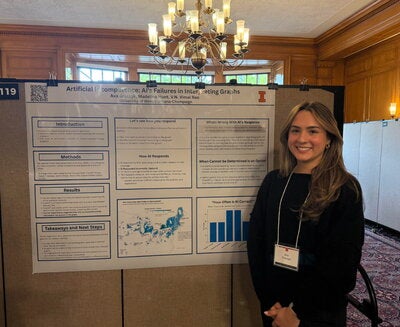
Artificial Incompetence: AI's Failures in Interpreting Graphs
Ava Graczyk, freshman in Learning and Education Studies, and Madeline Hunt, senior in Psychology and Statistics, examined how artificial intelligence systems interpret graphical information and where those systems continue to struggle.
For Graczyk, one of the most rewarding aspects of the project was seeing students engage with questions surrounding artificial intelligence.
"AI is a hot topic of our conversations these days," she said. "People go to school, people have years of experience, but AI is something that we all are on the same learning field for right now, and I think it's very important to highlight how cool the conversations can be when we are all curious about it together."
The team hopes future studies will continue evaluating how AI systems evolve over time and compare the performance of different AI models on graph interpretation tasks.
Challenging Students to Think for Themselves
Madison King, a sophomore majoring in Psychology, explored instructional approaches that encourage students to develop independent problem-solving and critical thinking skills. King conducted the research under the mentorship of Rao and Emily Buhnerkempe of University High School.
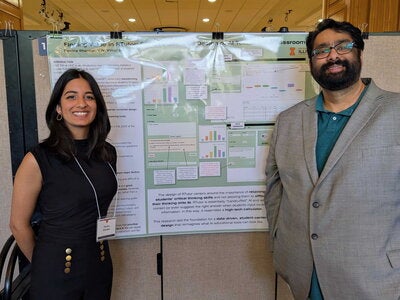
Finding Value in RTutor: Student-Centered Design of AI Tools in Statistics Classrooms
Pavitra Shankar, a sophomore majoring in Brain and Cognitive Science and Information Sciences, investigated student experiences using RTutor, an AI-powered learning tool utilized in STAT 100.
RTutor enables students with little or no programming experience to create statistical analyses and visualizations by translating pseudocode into R. Shankar's research examined how students use the tool and helped inform a student-centered redesign focused on improving learning outcomes while maintaining critical thinking skills.
"My UX research collected data on students' experience with RTutor, an AI-powered tool used in STAT 100," Shankar said. "Our goal is for students to find value in RTutor as a tool that both retains their critical thinking skills and improves their learning process."
Shankar also credited Rao's mentorship as a highlight of her undergraduate research experience.
"The highlight of my experience has been Professor Rao's mentorship as I began my venture into research," she said.
In addition to their symposium recognition, Graczyk, Hunt, King, and Shankar will present their research later this year at the 2026 Electronic Conference on Teaching Statistics, providing an opportunity to share their findings with a national audience of statistics and data science educators.
The Department of Statistics was also represented among the Outstanding Oral Presentation and Performance award recipients. Samuel Wu, a junior majoring in Statistics, received an Outstanding Oral Presentation Award for his project, Data-Compute Asymmetry in LLM Training: Quantifying the Impacts of Data Scarcity for Low-Resource African Languages. Wu conducted the research alongside Saathveek Gowrishankar under the mentorship of Haileleol Tibebu in the School of Information Sciences.
The recognitions highlight the impact of undergraduate research within statistics and data science, as students contribute to projects spanning artificial intelligence, education research, human-computer interaction, and machine learning.